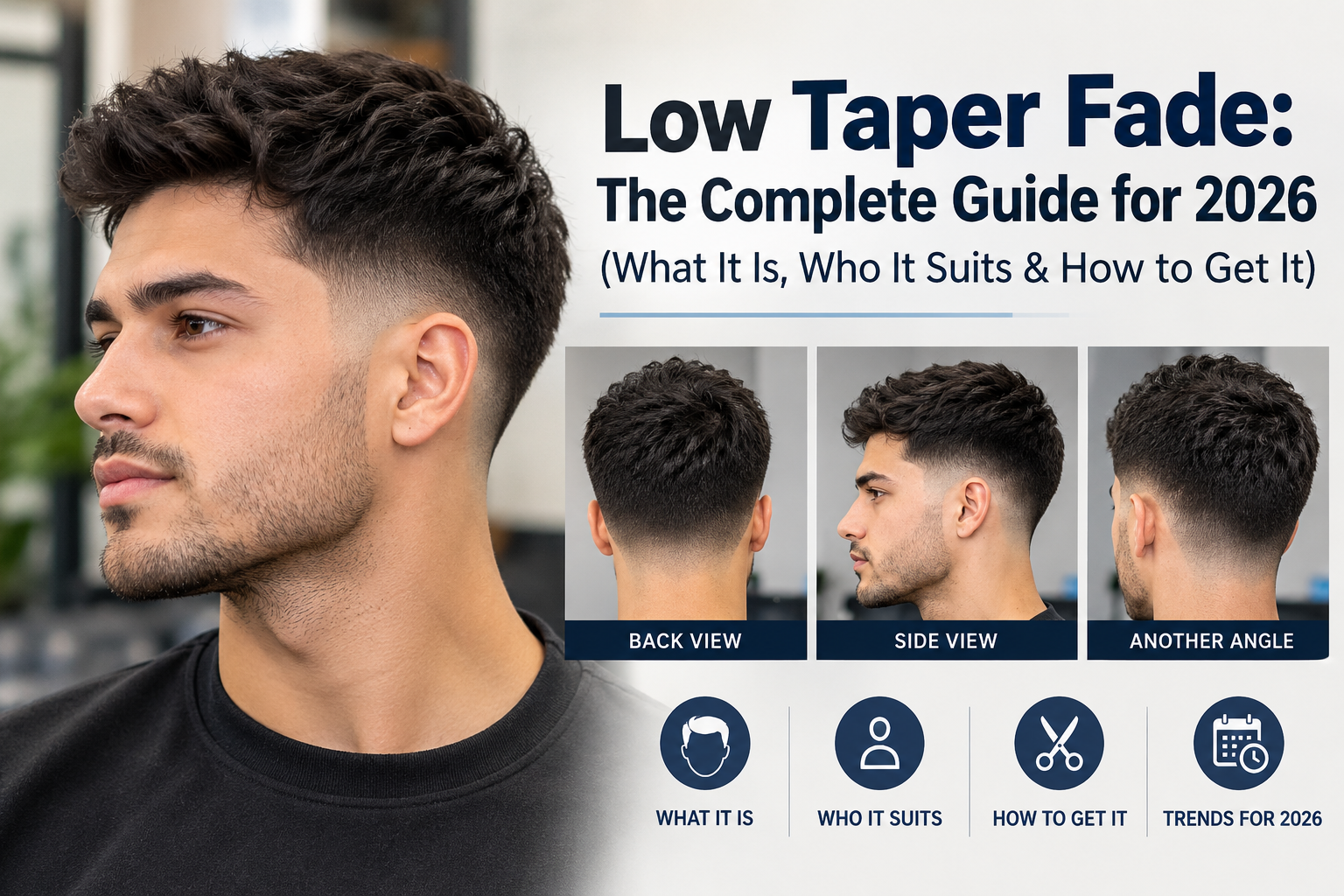
The low taper fade is the haircut most barbers in 2026 will tell you they cut more than anything else. It is subtle enough for an office, clean enough for a wedding, and flexible enough to sit under almost any style on top, from a messy textured crop to tight coils. If you are new to fades, or you have been asking for "short on the sides" for years and want something sharper, this guide explains exactly what a low taper fade is and how to get the version that suits you.
This is our pillar guide. Every other article on RedRunIt goes deeper into one specific variation, and we link to them throughout so you can jump straight to the style you care about.
What Is a Low Taper Fade?
A low taper fade is a haircut where the hair gets gradually shorter only around the lower edges of the head: the sideburns, the area just above and behind the ears, and the nape of the neck. The shortest point sits low, close to the natural hairline, and the length blends upward into the longer hair on the sides and top.
Two words in the name do the work:
- Low describes where the transition starts. On a low cut, the shortest hair sits roughly at or just above the top of the ear, and often lower at the back. Compare that with a mid fade (around the temple) or a high fade (near the parietal ridge, where the head starts to curve toward the crown).
- Taper describes how much hair is removed. A pure taper only shortens the hairline edges and leaves most of the sides at a normal length. A fade usually goes down to the skin or close to it. The phrase "low taper fade" sits between the two: it is a low, compact transition that often finishes very short at the sideburn and nape, but it does not wrap a wide band of skin around the head.
The result is a cut that looks finished and deliberate while still reading as "natural" from a distance. When the cut grows out, it grows out gracefully, which is a big reason it has become so popular.
Quick definition to show your barber: "A low taper fade: the sides stay fairly full, and the hair blends short only at the sideburns and neckline, starting low, around the top of the ear."
Low Taper Fade at a Glance
| Feature | Details |
|---|---|
| Where the fade starts | At or just above the top of the ear; lower at the nape |
| Shortest length | Usually a #0.5 to #1 guard, or bare skin right at the edge |
| Visible skin | Minimal: a small area at the sideburn and nape |
| Best for | Almost all hair types, offices, schools, first-time fades |
| Upkeep | Touch-up every 2 to 3 weeks to keep it crisp |
| Grow-out | Very forgiving; still looks tidy at 4 weeks |
| Pairs with | Textured crops, curls, fringes, quiffs, waves, twists, long hair |
Why the Low Taper Fade Is So Popular
It flatters most head shapes. Because the shortest part is low and small, it does not expose the shape of the skull the way a high skin fade does. If you have a bump at the back of the head or a flatter crown, a low taper hides it far better.
It keeps width where you need it. Many faces look best when the sides of the head are not stripped completely. A low taper keeps hair above the ear, which softens a long or narrow face and stops the head looking "pinned" at the top.
It is office-friendly. You get the clean neckline and sideburns of a fresh cut without a dramatic band of skin. Read our guide to the low taper fade for work if your workplace is conservative.
It works under almost anything. Curls, straight hair, waves, coils, locs, long hair tied back: the taper is just a clean frame. That is why you will see it paired with styles as different as the French crop and the afro.
It grows out well. A high skin fade looks fuzzy within a week. A low taper still looks intentional after three or four, which saves money and barber visits.
Low Taper vs Mid and High Taper
The height of the fade changes the whole personality of the cut. We cover this properly in low vs mid vs high taper fade, but here is the short version:
- Low taper: starts around the top of the ear. Subtle, conservative, maximum versatility.
- Mid taper: starts around the temple, roughly halfway up the side. More contrast and a sportier look.
- High taper: starts near the parietal ridge. Bold, high-contrast, more upkeep.
If you are unsure, start low. You can always go higher on the next visit; you cannot put hair back.
Taper vs Fade: Is There a Difference?
Yes, and it matters when you talk to a barber. A taper is generally a conservative cut that shortens hair at the hairline and leaves the rest of the sides longer. A fade typically blends down to very short or bare skin over a larger area. "Low taper fade" is a modern hybrid term that most barbers understand as a low, tight transition with minimal skin. Our full breakdown is in taper vs fade: what's the real difference.
Who Should Get a Low Taper Fade?
Hair types
A low taper fade works on every hair type, but it behaves differently on each:
- Straight hair shows every clipper line, so the blend needs to be precise. See low taper fade with straight hair.
- Wavy hair benefits because the taper removes the puffiness above the ears while keeping movement on top. See wavy hair.
- Curly and coily hair looks sharper and more defined when the sides are tapered. See curly hair and afro.
- Thick hair loses bulk without losing shape. See thick hair.
- Thin or fine hair looks fuller when the sides are kept slightly longer and the taper stays low. See thin hair.
Face shapes
Low tapers are kind to almost every face shape because they do not dramatically narrow the head. Round faces benefit from a little height on top; long faces benefit from keeping some width at the sides. Our face shape guide goes into detail.
Lifestyle
If you see a barber every two weeks, any fade works. If you can only manage a cut every four to six weeks, the low taper is the smartest fade you can choose, because it ages the slowest.
The Most Popular Low Taper Fade Styles
The taper is only half the haircut. What you do on top decides the look. These are the combinations we get asked about most, each with its own detailed guide:
- Textured crop: short, choppy top with a blunt or messy fringe. Low maintenance, very current.
- French crop: a cleaner, straighter fringe with a classic European feel.
- Textured fringe and fringe: forward-falling hair that softens the forehead.
- Curtains and middle part: center-parted styles that are popular with medium-length hair.
- Quiff and pompadour: volume swept up and back.
- Side part and comb over: the smart, classic options.
- Slick back: polished, high-shine, made for formal events.
- Edgar and Caesar: short, straight-across fringe styles.
- Crew cut and buzz cut: short all over, easiest possible upkeep.
- Blowout and fluffy hair: big, airy volume.
- Modern mullet and long hair: length at the back or all over, clean edges.
- Twists, braids and dreads: protective styles framed by a sharp taper.
How to Ask Your Barber for a Low Taper Fade
Most bad fades come from vague requests. Use specifics:
- Say where the fade starts. "Low, starting around the top of the ear and lower at the back."
- Say how short it goes. "Take it down to a half guard at the bottom" or "down to skin only right at the edge."
- Say what stays on the sides. "Keep a #3 or #4 above the taper so it does not look too thin."
- Say what happens on top. "Leave three inches on top and texture it" or "keep my curls, just shape them."
- Say how you want the edges. "Natural neckline" or "tapered neckline" rather than a blocked line, unless you want a line-up.
- Bring a photo, ideally of someone with your hair type.
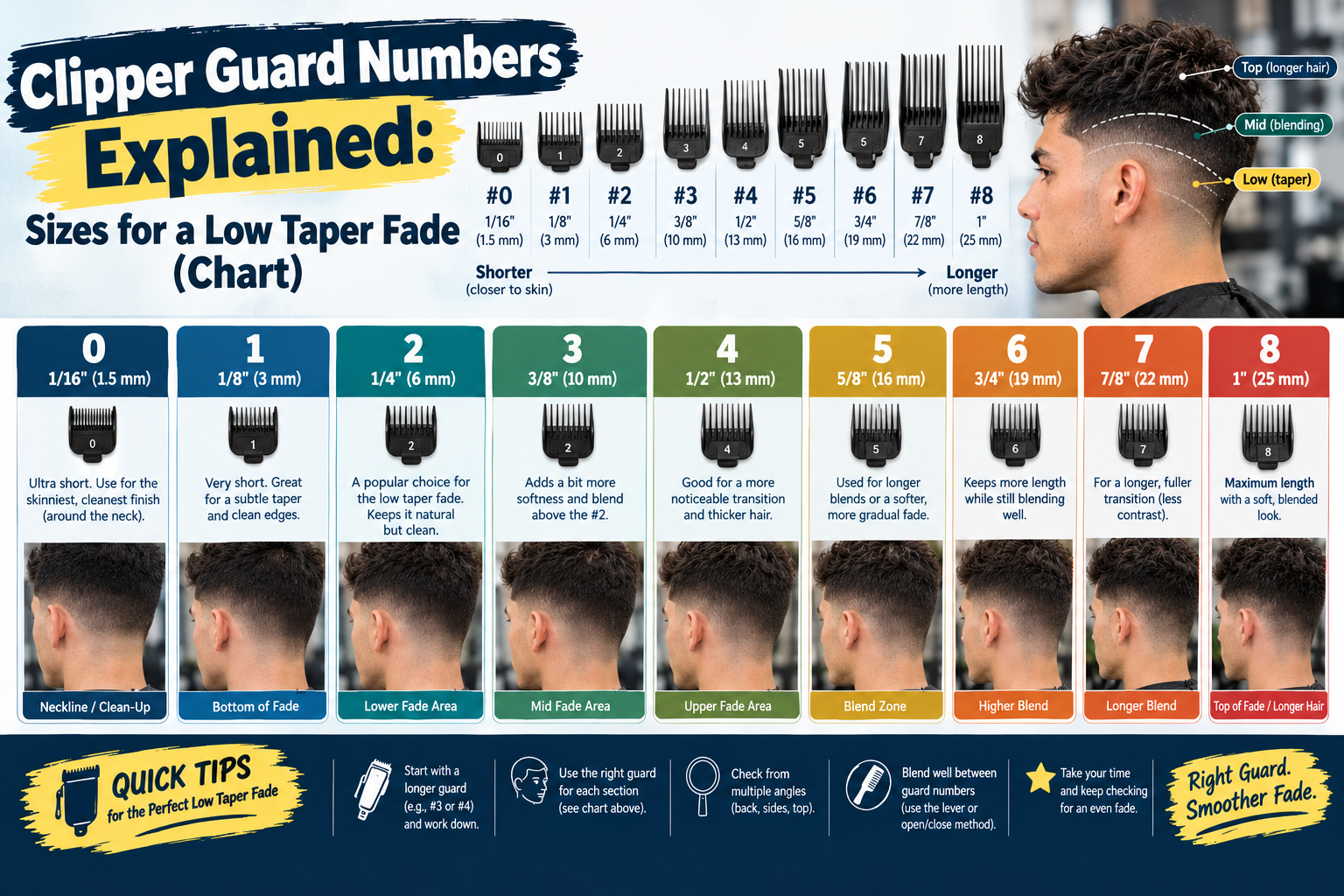
We wrote a complete script with guard numbers in how to ask your barber for a low taper fade. If you want to understand the numbers your barber uses, read our clipper guard numbers guide.
Typical Clipper Lengths for a Low Taper Fade
Every barber has a method, but a common progression looks like this:
| Zone | Typical length |
|---|---|
| Very bottom edge (sideburn, nape) | Bare blade, #0 or #0.5 |
| First blend | #1 |
| Second blend | #1.5 or #2 |
| Sides above the taper | #3 to #4, or scissor-cut |
| Top | Scissor-cut, anywhere from 1 to 6 inches |
On a very conservative low taper, the barber might never go below a #1 and only use bare skin on the outline.
How to Style a Low Taper Fade
Styling depends on the top, but the basic routine is the same:
- Start with towel-dried, slightly damp hair. Do not try to style soaking wet hair.
- Pre-style if you want volume. A light spray or a little sea salt spray, then a blow-dryer on medium heat, directing hair the way you want it to sit.
- Choose a finishing product for your look. Matte clay or paste for texture, cream for soft natural hold, pomade for shine, curl cream or gel for curls. Our products guide explains which to use and why.
- Use less than you think. A pea-sized amount, warmed in your palms, is enough for most short styles.
- Leave the sides alone. The taper is the part that needs no styling. Keep product on top.
How Long Does a Low Taper Fade Last?
A low taper looks sharpest for about 10 to 14 days. After two weeks the very short hair at the bottom starts to soften the blend; by three to four weeks it looks more like a regular short cut. Most people book every 2 to 3 weeks for the taper and every 4 to 6 weeks for the top. Our maintenance guide has a full schedule and tips to stretch it.
Common Low Taper Fade Mistakes
- Going too high on the first cut. Low means low. If the fade climbs above the temple, it is a mid fade.
- Too much contrast with fine hair. Bare skin next to thin hair on top exaggerates thinness. Keep the bottom at a #0.5 or #1.
- Ignoring the neckline. A blocked, squared neckline grows out badly. A tapered neckline grows out naturally.
- Over-styling the top. Heavy, wet-look product on a textured cut kills the effect. Matte products suit most modern low taper styles.
- Skipping the touch-up. A low taper does not need a full cut every two weeks, but a quick clean-up of the edges keeps it looking deliberate.
Can You Cut a Low Taper Fade at Home?
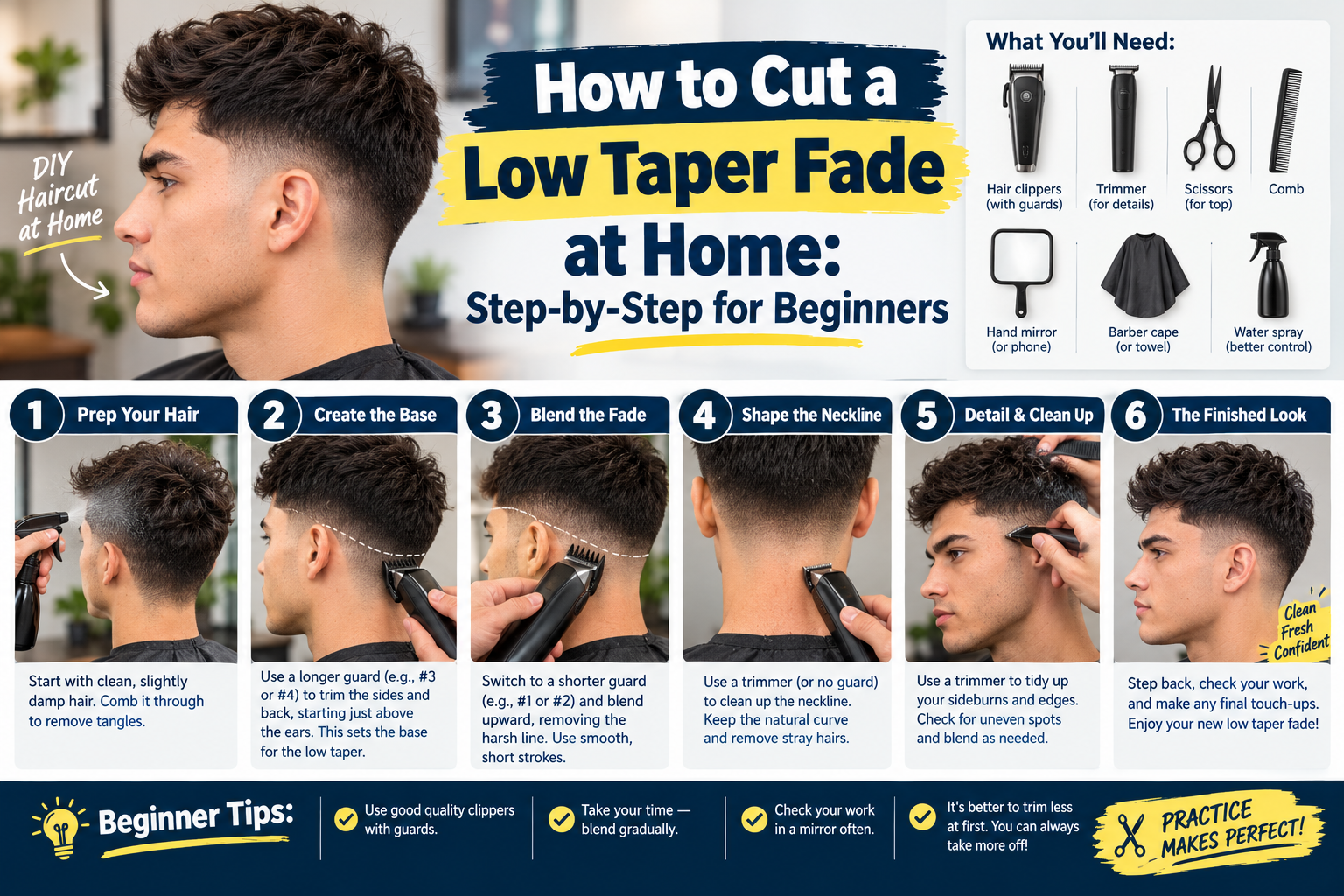
You can, with the right clippers, patience and two mirrors. The low version is actually the easiest fade to attempt at home because mistakes are low on the head and easier to hide. Follow our step-by-step guide on how to cut a low taper fade at home before you start, and practice on the neckline first.
Frequently Asked Questions
What is the difference between a low taper and a low fade?
A low taper keeps more length on the sides and only shortens the hairline edges, usually around the sideburns and nape. A low fade blends to very short or bare skin over a wider band around the lower part of the head. A "low taper fade" is the hybrid most barbers cut today: a low, compact transition with minimal visible skin.
Is a low taper fade good for beginners?
Yes. It is the safest fade to try first because it is subtle, suits most head shapes and grows out gracefully. If you like it, you can try a mid or burst fade next time.
How often should I get a low taper fade?
Every 2 to 3 weeks keeps it crisp. If you want to save money, ask for an edge-up (cleaning the sideburns and neckline) between full cuts.
Does a low taper fade work with long hair?
Absolutely. A low taper is one of the best ways to keep long hair looking tidy, because it cleans up the area around the ears and neck without changing the length on top. See our long hair guide.
Is a low taper fade professional?
It is one of the most professional fades you can get. The visible skin is minimal and the cut looks neat from every angle, which is why it is popular in offices, schools and uniformed jobs.
What should I say to my barber?
Something like: "Low taper fade, starting around the top of the ear, down to a half guard at the bottom, keep a #3 above it, and leave the top long enough to style." Bring a photo of someone with similar hair.