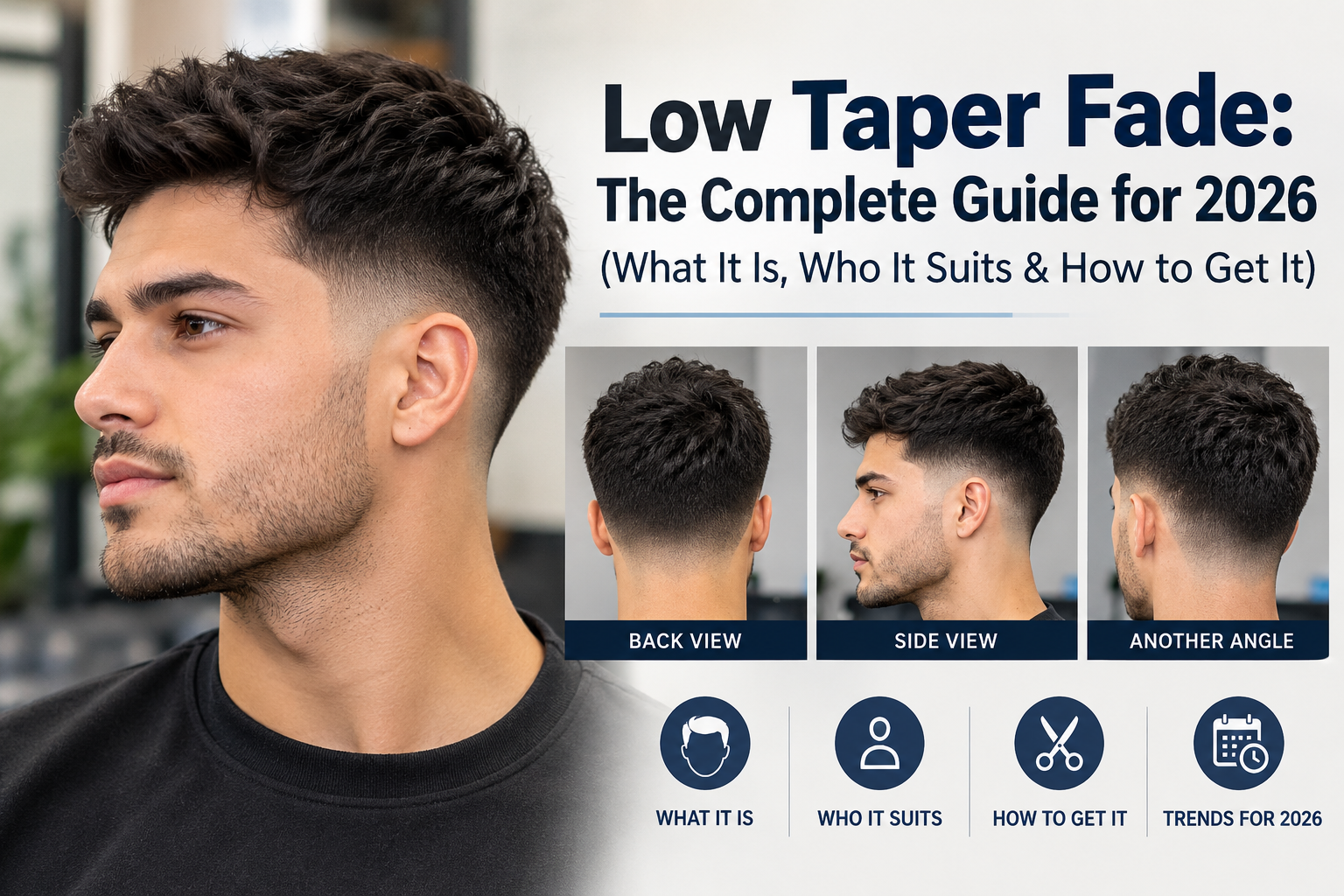
A fringe changes your whole face. It can shorten a long face, cover a high or receding hairline, soften strong features and instantly make a haircut look modern. With a low taper fade on the sides, the fringe becomes the focus while the outline stays clean.
This guide covers the main types of fringe you can wear with a low taper fade. For the choppiest version, see our dedicated textured fringe guide.
Quick Facts
| Top length | 1.5 to 5 inches |
| Fringe length | Mid-forehead to eyebrows (or longer) |
| Fade height | Low |
| Bottom length | #0.5 to skin |
| Best hair types | Straight, wavy, loose curls, thick |
| Face shapes | Oblong, oval, diamond, heart, square |
| Product | Matte clay, paste, sea salt spray |
Types of Fringe
| Fringe type | Look | Best for |
|---|---|---|
| Short blunt fringe | Neat, straight line high on the forehead | French crop, Edgar, Caesar |
| Textured fringe | Choppy, messy pieces | Modern casual style |
| Heavy fringe | Thick, reaching the eyebrows | Long faces, high foreheads |
| Side-swept fringe | Angled to one side | Softer features, round faces |
| Curly fringe | Curls falling forward | Curly hair |
| Long fringe | Below the eyebrows, often pushed aside | Medium to long hair |
12 Best Low Taper Fade Fringe Styles
1. Short Blunt Fringe
A crisp, straight line. Clean and defined. Closely related to the French crop.
2. Textured Fringe
Choppy and messy. See textured fringe.
3. Heavy Fringe
Thick and dense to the eyebrows. Covers a high forehead completely.
4. Side-Swept Fringe
The fringe angles toward one side. Good for round faces.
5. Edgar Fringe
A sharp straight-across fringe with a defined edge. See Edgar.
6. Caesar Fringe
Very short, horizontal fringe. See Caesar cut.
7. Curly Fringe
Curls falling forward. See curly hair.
8. Wavy Fringe
Natural movement. See wavy hair.
9. Long Fringe
Below the eyebrows, pushed to the side or parted. A bridge toward curtains.
10. Fringe with a Skin Taper
Bare skin at the bottom. See skin taper.
11. Fringe with a Burst Fade
Edgy curved fade. See burst fade.
12. Fringe Mullet
Fringe at the front, length at the back. See modern mullet.
Which Fringe for Your Face Shape?
- Long face: heavy or blunt fringe to shorten.
- Round face: side-swept or short textured fringe; avoid heavy blunt fringes.
- Square face: textured fringe to soften angles.
- Diamond or heart: textured or side-swept fringe to widen the forehead area.
More detail in our face shape guide.
How to Ask Your Barber
"Low taper fade, half guard at the bottom. On top, [X] inches with a [short blunt / textured / heavy / side-swept] fringe that sits at [mid-forehead / eyebrows]. [Point-cut it / cut it straight across]."
How to Stop a Fringe from Splitting
Many people have a cowlick at the front that splits the fringe.
- Blow-dry the fringe forward and down while wet, using a comb to direct it.
- Dry the roots against the cowlick first, then in the direction you want.
- Use a matte clay to hold.
- Ask your barber to leave the fringe slightly heavier where the cowlick is.
Fringe Styles Across Hair Types
| Hair type | Fringe that works best | Watch out for |
|---|---|---|
| Straight | Blunt, French crop or long fringe | Fringe lying too flat; blow-dry for lift |
| Wavy | Textured or side-swept | Frizz in humidity |
| Curly | Curly fringe, cut dry | Shrinkage: cut longer than you think |
| Coily | Short shaped front or sponge-curl fringe | Dryness; moisturize daily |
| Thick | Heavy fringe with weight removed | Puffiness |
| Fine | Short textured fringe | Separation; use matte product sparingly |
Fringe Maintenance at Home
Between barber visits, you can carefully trim a fringe yourself:
- Use sharp hair scissors, never kitchen scissors.
- Dry and style the fringe first so you see the true length.
- Hold the scissors vertically and snip into the ends (point cutting) rather than cutting straight across.
- Take off very little at a time; you can always cut more.
If the fringe needs more than a small tidy, see your barber.
Fringe vs No Fringe
A fringe is great for covering a high or receding hairline, shortening a long face and looking younger. It is less ideal if you work out often (sweat makes it stick to the forehead), wear glasses that catch the hair, or have a strong cowlick at the front. If you are unsure, try a short textured fringe first. It is easy to grow into something longer.
Frequently Asked Questions
Does a fringe make you look younger?
Often yes. A fringe softens the forehead and gives a more youthful look.
What's the best fringe for a receding hairline?
A short textured or blunt fringe, like a French crop. See receding hairline.
How often should I trim my fringe?
Every 3 to 5 weeks, depending on how long you want it.
Can I have a fringe with curly hair?
Yes. Curly fringes look great, especially with a low taper. Keep curls moisturized.