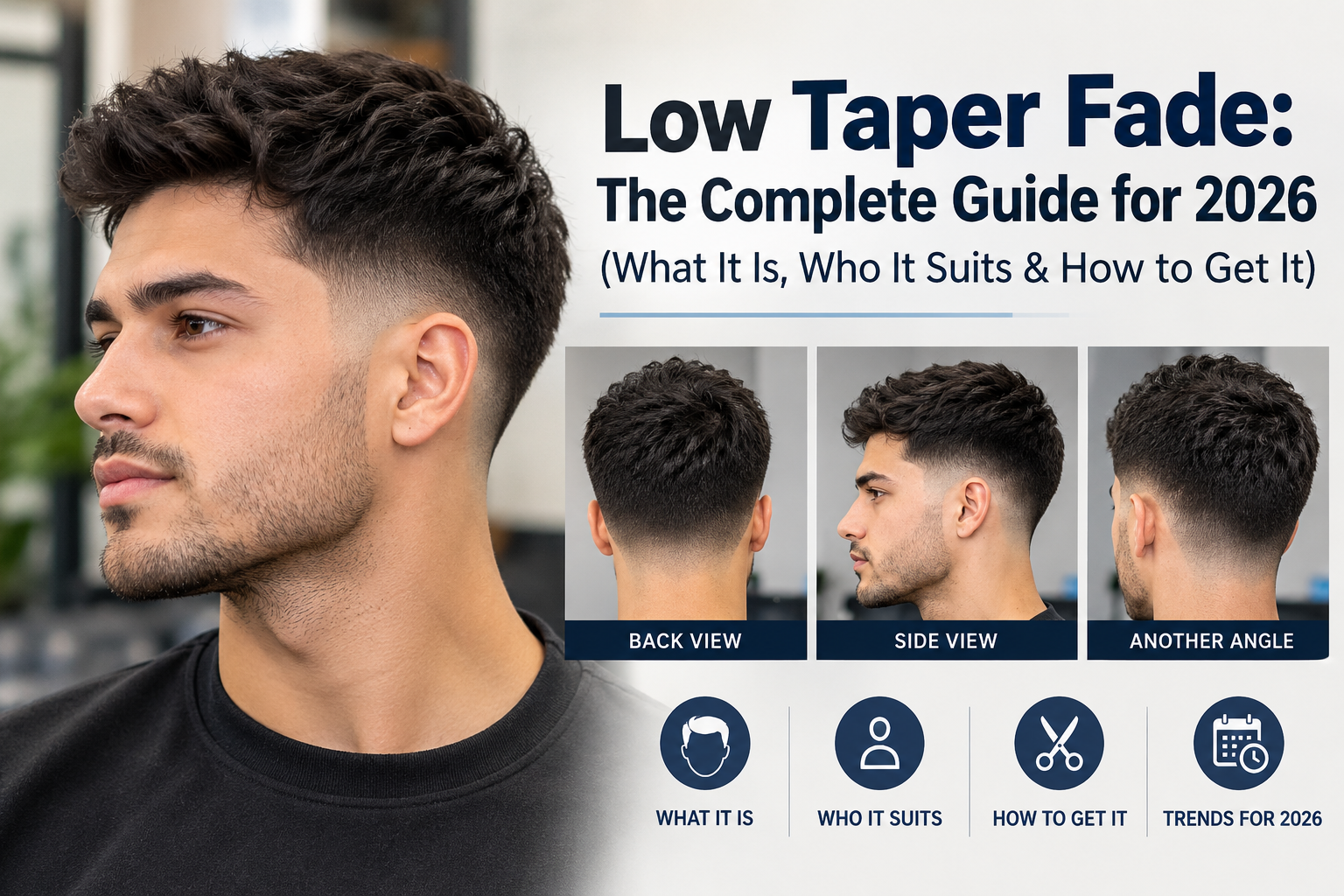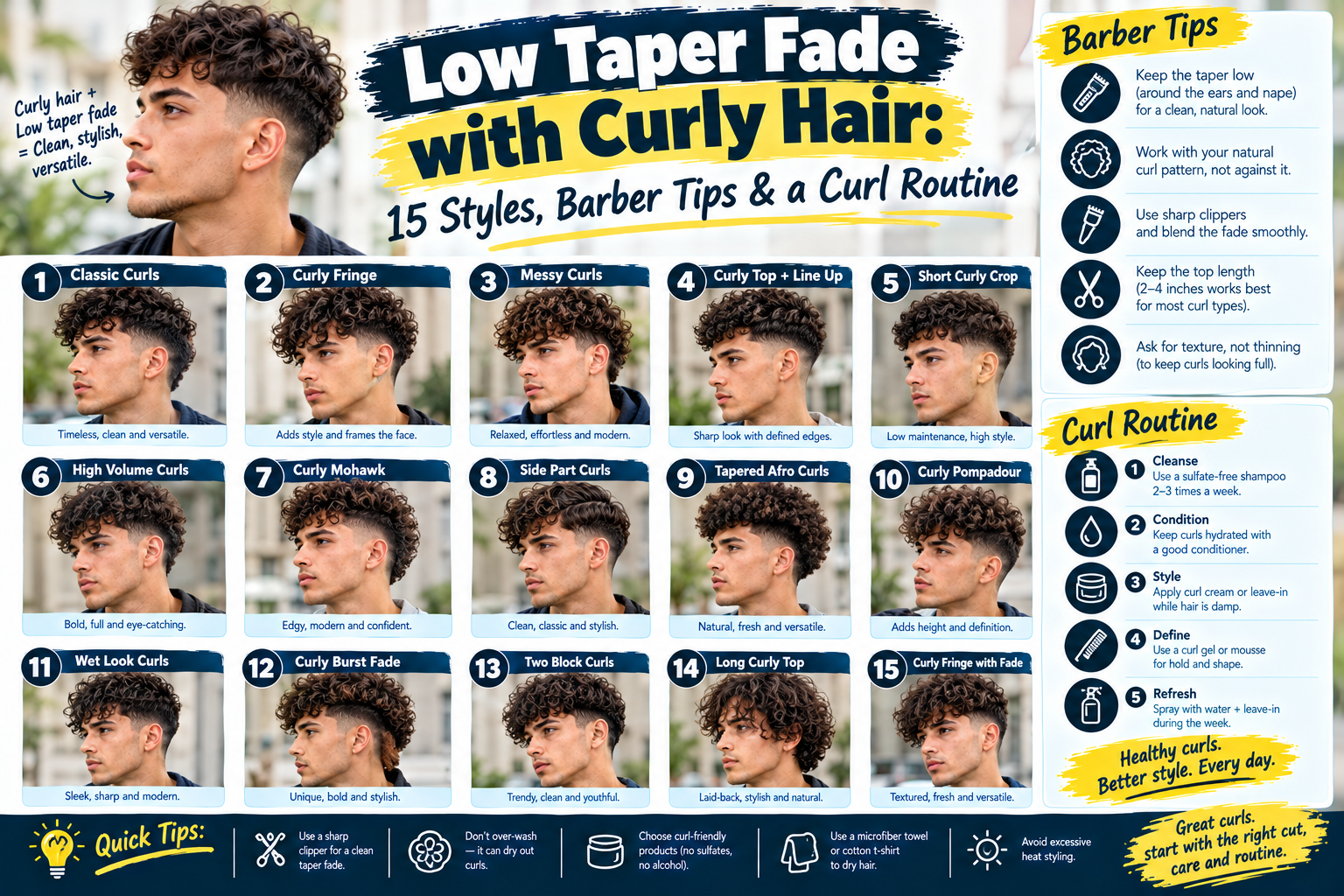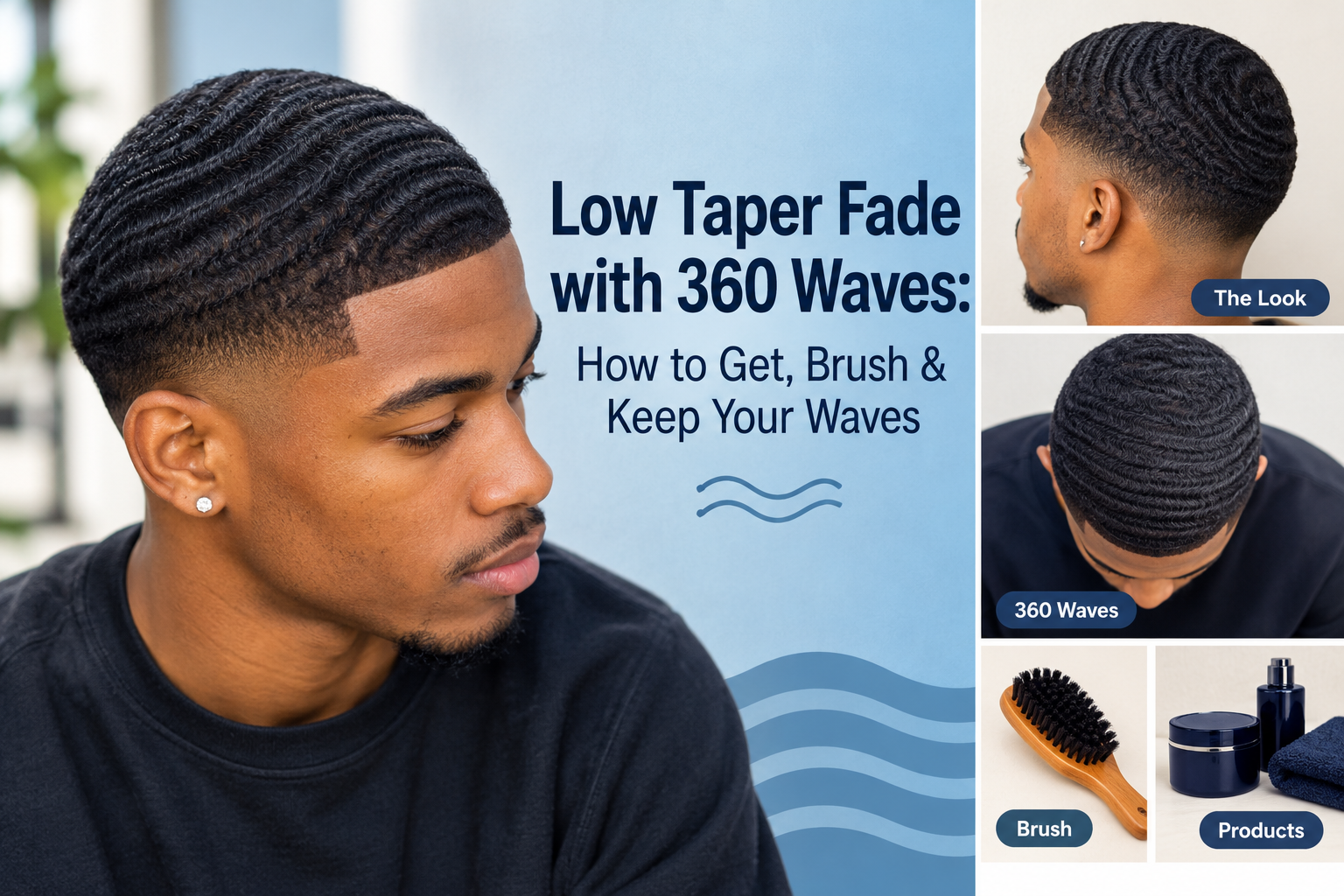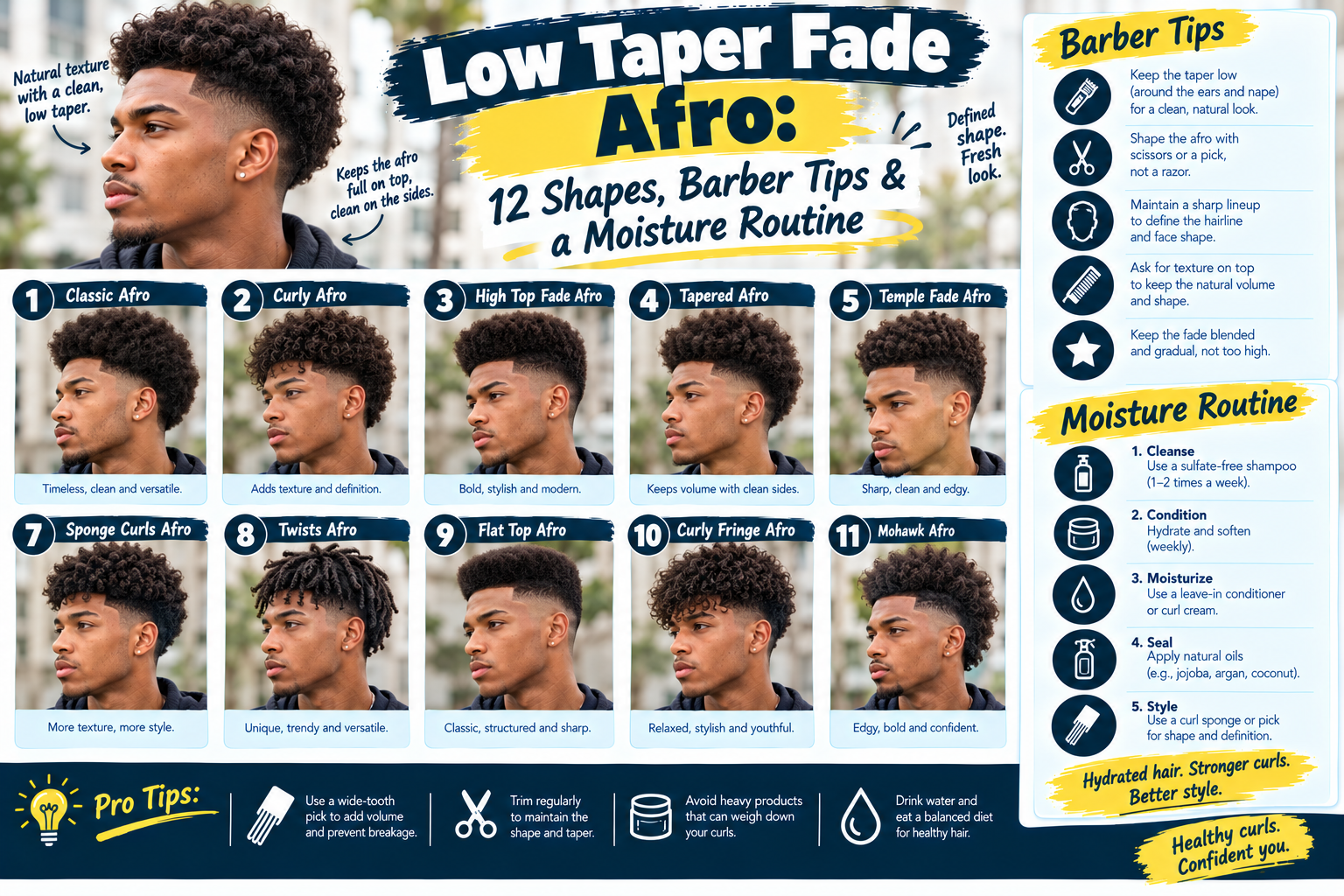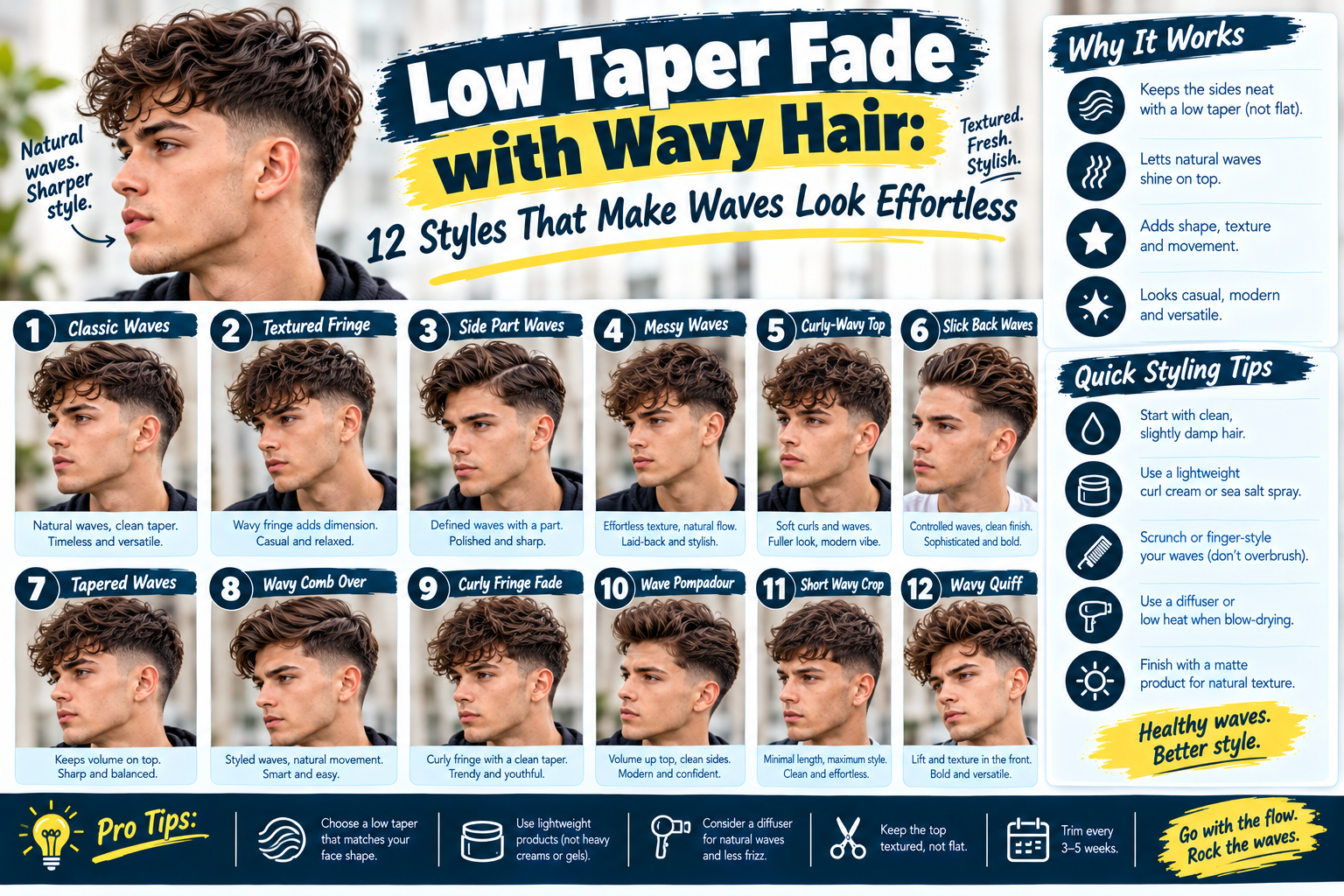
Wavy hair sits between straight and curly, and that gives it a big advantage: natural movement without the high maintenance of tight curls. Its weakness is bulk and frizz, especially above the ears, where waves tend to puff out. A low taper fade fixes exactly that. It removes the width at the sides and leaves the waves on top free to move.
Quick Facts
| Wave types | 2A (loose), 2B (defined S-shape), 2C (near-curly) |
| Fade height | Low |
| Bottom length | #0.5 to skin |
| Top length | 2 to 6 inches works best |
| Touch-up | Every 2–4 weeks |
| Key products | Sea salt spray, light cream, curl cream for 2C |
Why Wavy Hair Loves a Low Taper
- Removes the "triangle shape." Wavy hair often gets wider toward the bottom. Tapering the sides creates a better silhouette.
- Grows out softly. Waves hide regrowth, so a low taper on wavy hair lasts longer than on straight hair.
- Keeps it versatile. You can wear the top messy, parted, pushed back or forward.
12 Best Low Taper Fade Styles for Wavy Hair
1. Messy Wavy Crop
2 to 3 inches of waves, scrunched with sea salt spray and left loose. Effortless and modern.
2. Wavy Curtains
Center-parted waves falling to the cheekbones. The most popular wavy style of the moment. See curtains.
3. Wavy Textured Fringe
Waves pushed forward over the forehead in uneven pieces. See textured fringe.
4. Wavy Quiff
Waves lifted at the front and swept back loosely. Less structured than a straight-hair quiff, more natural. See quiff.
5. Wavy Side Part
A soft, natural part with waves falling across. Smart without looking stiff. See side part.
6. Wavy Fluffy Hair
Blow-dried with a diffuser for airy volume. See fluffy hair.
7. Wavy Modern Mullet
Wavy hair is perfect for mullets because the back flows naturally. See modern mullet.
8. Long Wavy Hair
Shoulder-length waves with tapered edges around the ears. See long hair.
9. Wavy Slick Back
Waves combed back with a cream rather than a strong pomade, so some texture survives. See slick back.
10. Wavy Middle Part
A cleaner, more defined version of curtains. See middle part.
11. Wavy Hair with a Beard
Waves and a well-shaped beard create a relaxed, rugged look. See with beard.
12. Short Wavy Crew Cut
For minimal maintenance: short waves on top that add texture to a classic crew cut. See crew cut.
How to Ask Your Barber
"I have wavy hair that gets puffy above the ears. Low taper fade, starting at the top of the ear, half guard to skin at the bottom, and take the bulk out of the sides. On top, keep the waves: about [X] inches, cut dry if possible, with some layering so it isn't heavy."
Layering on top helps waves form, because removing weight lets each wave spring up.
How to Enhance Natural Waves
- Do not wash daily. Natural oils help waves form. Wash every 2–3 days.
- Apply sea salt spray or a light cream to damp hair.
- Scrunch upward with your hands to encourage the wave pattern.
- Air-dry or diffuse on low heat. Avoid brushing.
- Finish with a tiny amount of cream to smooth frizz on the surface.
For 2C waves that are close to curls, use the routine in our curly hair guide.
Common Mistakes
- Brushing dry hair, which kills the wave pattern.
- Heavy products that weigh waves down and straighten them.
- Skipping conditioner: waves need moisture to stay defined.
- Leaving bulk on the sides, which makes the head look wider than it is.
Wavy Hair Through the Seasons
Wavy hair changes with the weather more than any other hair type, so it helps to plan your low taper around the climate you live in.
Humid weather. Moisture in the air makes waves expand and frizz. Keep the top slightly shorter (2 to 3 inches) so the extra volume stays manageable, and use a light curl cream instead of sea salt spray, which can make frizz worse. A low taper is especially useful here because the sides stay flat even when the top grows.
Dry or cold weather. Waves loosen and can look limp. Let the top grow a little longer (3 to 5 inches) to give the wave pattern more room to form, and add a leave-in conditioner because indoor heating dries hair out.
Summer and swimming. Chlorine and salt water dry waves out quickly. Rinse with fresh water after swimming and apply conditioner. A shorter top plus a fresh taper makes post-swim hair look intentional rather than messy.
Wavy Hair Styling by Occasion
| Occasion | Style | Product |
|---|---|---|
| Everyday | Messy crop or textured fringe | Sea salt spray |
| Office | Soft side part | Light cream |
| Date or event | Curtains or a loose quiff | Cream plus a little matte clay |
| Gym or sport | Pushed back, air-dried | Nothing, or leave-in conditioner |
Growing Out Wavy Hair with a Low Taper
Wavy hair often goes through an awkward stage between 3 and 5 inches, when the waves start to stick out sideways. Keeping the low taper fresh every 3 weeks during this stage is the trick: the sides stay neat while the top grows into longer waves. Ask your barber to only "dust" the ends on top (remove a few millimetres) while the taper is refreshed.
Wavy or Curly? How to Tell
If your hair forms loose S-shapes that relax when brushed, it is wavy (2A–2C). If it forms spirals or ringlets that spring back after stretching, it is curly. Many people have both: wavy at the front, curlier at the back. In that case, use the gentler wavy-hair routine above and add curl cream only where the curls are tighter. Our curly hair guide covers the curlier end of the spectrum.
Frequently Asked Questions
Is a low taper fade good for wavy hair?
Yes. It removes the bulk above the ears that wavy hair tends to build up, while keeping the waves on top.
How do I make my waves more defined?
Use a sea salt spray or light curl cream on damp hair, scrunch, and let it dry without touching it.
How long should wavy hair be on top?
2 to 6 inches. Waves need some length to form; very short wavy hair can look straight.
Can wavy hair have a skin fade?
Yes, a skin finish at the very bottom works well. Waves on top soften the contrast.