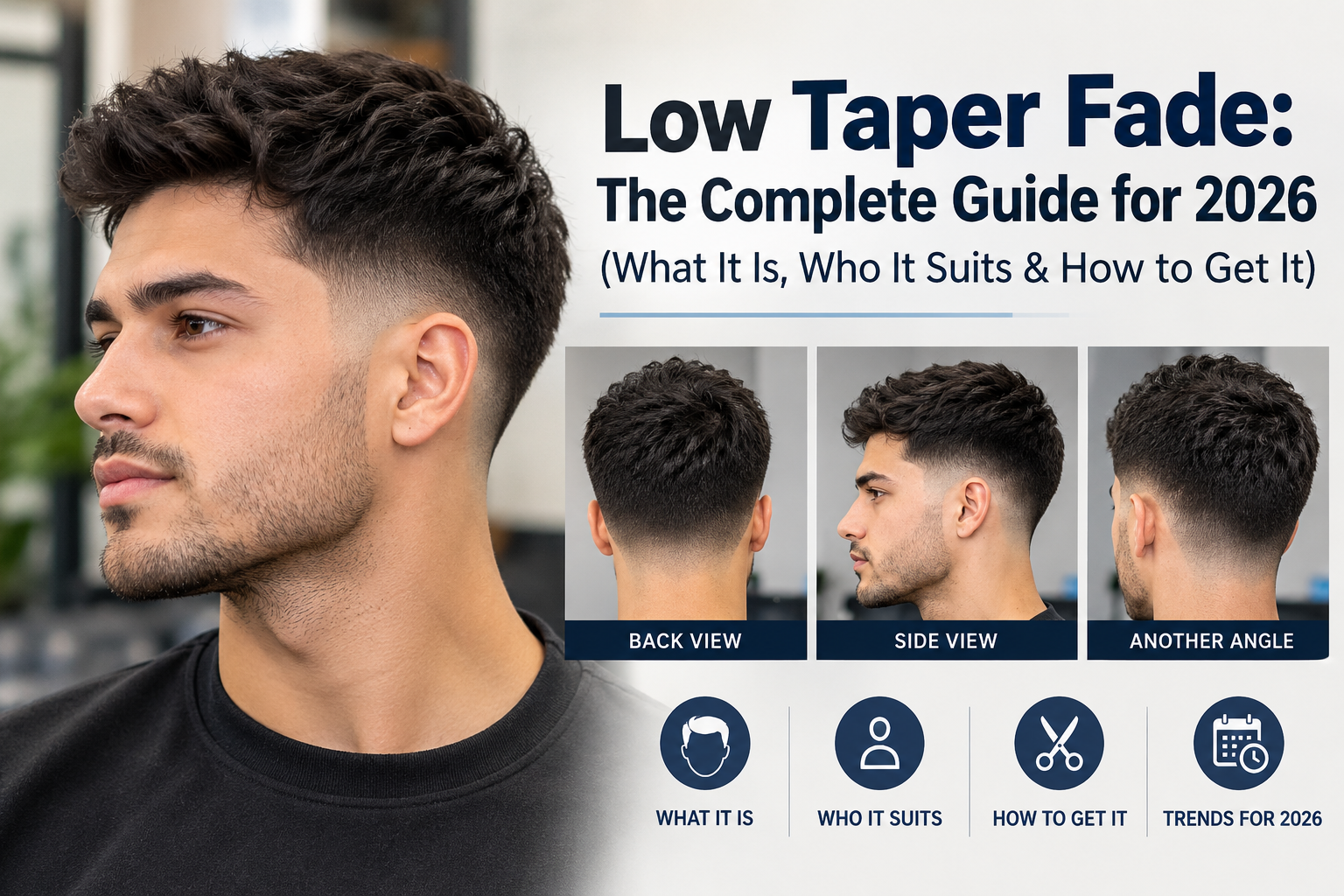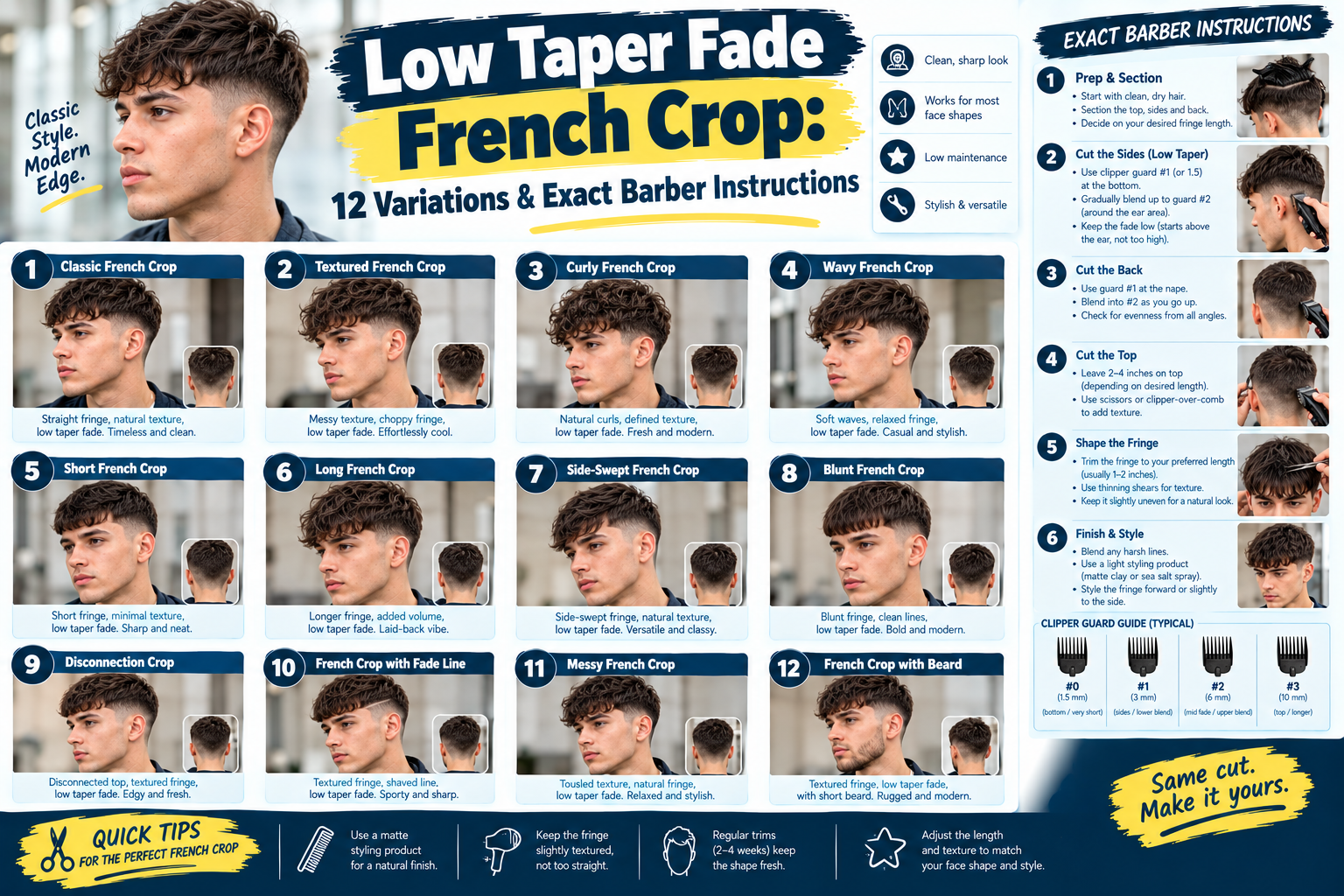
The textured fringe is the defining men's haircut of the mid-2020s. It is relaxed, youthful and easy to wear, with choppy pieces of hair falling forward onto the forehead. Pair it with a low taper fade, and you get a cut that looks modern on day one and still looks good three weeks later.
Quick Facts
| Top length | 2 to 4 inches, longer at the front |
| Fringe length | Mid-forehead to eyebrows |
| Fade height | Low |
| Bottom length | Skin to #0.5 |
| Best hair types | Straight, wavy, loose curls, thick hair |
| Face shapes | Oval, oblong, diamond, heart, square |
| Product | Matte clay, paste, sea salt spray |
| Styling time | 2–4 minutes |
Textured Fringe vs Textured Crop vs French Crop
These three are related but different:
- Textured crop: shorter overall, with a short choppy fringe. More compact.
- French crop: a cleaner, straighter, more uniform fringe.
- Textured fringe: longer and looser; the fringe is the star. More movement and messiness.
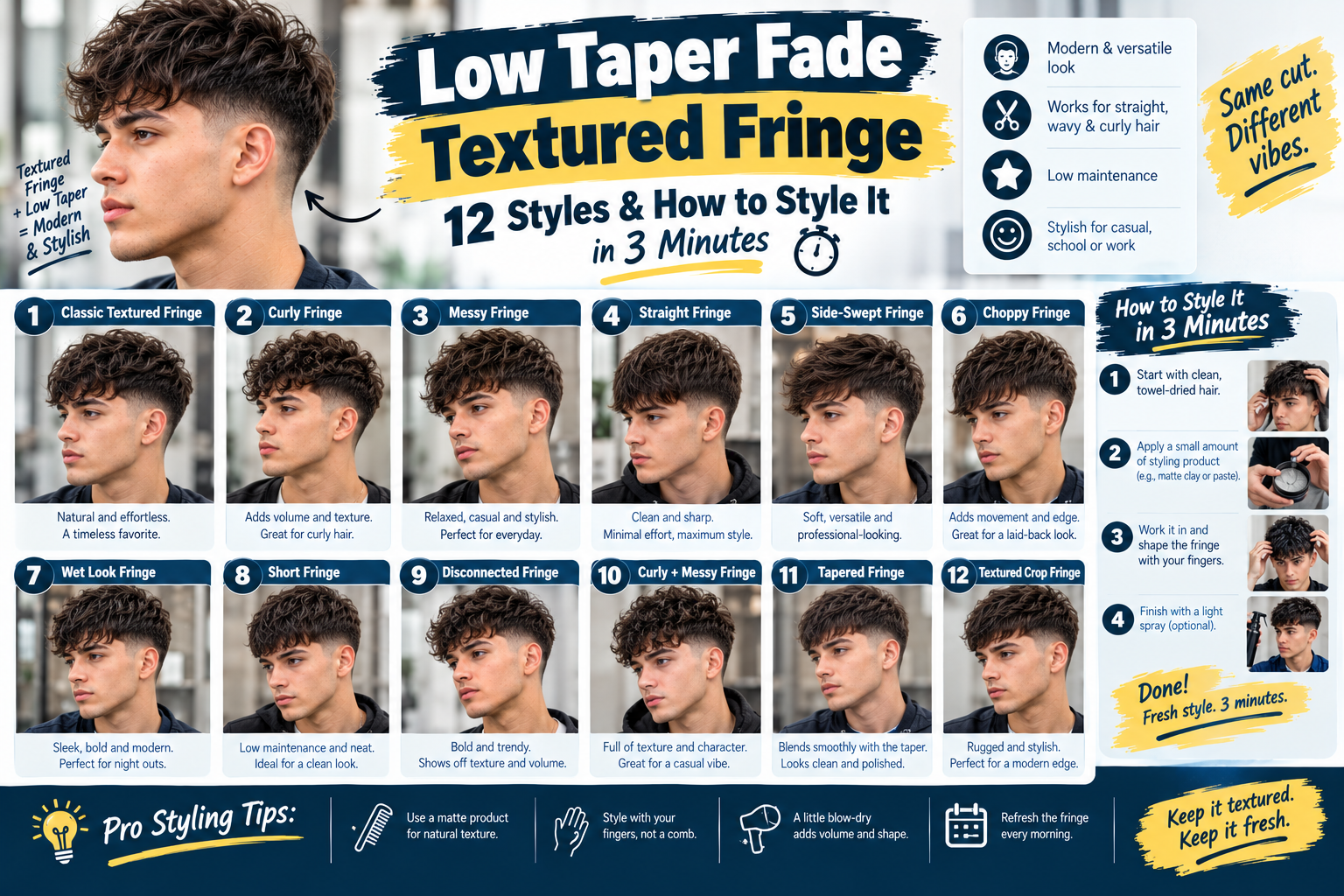
12 Best Low Taper Fade Textured Fringe Styles
1. Classic Messy Textured Fringe
Choppy pieces falling unevenly onto the forehead, matte finish. The default version.
2. Heavy Textured Fringe
Thicker, denser fringe reaching the eyebrows. Great for oblong faces and high foreheads.
3. Short Textured Fringe
Fringe sits mid-forehead. Neater and easier to keep out of your eyes.
4. Side-Swept Textured Fringe
The fringe is pushed slightly to one side. Softer and a little more grown-up.
5. Curly Textured Fringe
Loose curls falling forward. See curly hair.
6. Wavy Textured Fringe
Waves add natural movement. See wavy hair.
7. Textured Fringe with a Skin Taper
Bare skin at the bottom for maximum contrast. See skin taper.
8. Textured Fringe with a Burst Fade
The fade curves around the ear. Edgier. See burst fade.
9. Textured Fringe Mullet
Fringe at the front, length at the back. See modern mullet.
10. Spiky Textured Fringe
Pieces lifted slightly at the ends for a more energetic look.
11. Blonde Textured Fringe
Lightened ends emphasize the texture. See blonde hair.
12. Textured Fringe with a Beard
A beard balances the fringe and adds maturity. See with beard.
How to Ask Your Barber
"Low taper fade, starting at the top of the ear, half guard at the bottom. On top, leave about 3 inches, longer at the front for a fringe that sits around my eyebrows. Point-cut it heavily so it's choppy and textured, not blunt."
Key phrases: point cut, choppy, not blunt, longer at the front.
How to Style a Textured Fringe in 3 Minutes
- Towel-dry until damp.
- Spray sea salt spray lightly throughout.
- Blow-dry forward with your fingers, ruffling the hair. Keep the dryer pointed down and forward.
- Warm a pea-sized amount of matte clay in your palms.
- Work it through from the back to the front, then pinch and twist the fringe into separate pieces.
- Leave it slightly imperfect. Over-styled fringes look stiff.
See our products guide.
Maintenance
- Taper: every 2–3 weeks.
- Fringe: trim every 4–6 weeks, or sooner if it gets in your eyes.
- Between cuts: you can trim the very ends of the fringe at home with scissors held vertically (point cutting), but go slowly.
Who Should Avoid It?
If you have a strong cowlick at the front, or very fine thinning hair at the hairline, a heavy fringe may be difficult. A short textured crop is often a better option.
How the Barber Creates Texture
Understanding the techniques helps you ask for the right finish:
- Point cutting: the barber snips vertically into the ends with scissors. This breaks up the blunt line and creates the choppy pieces that define a textured fringe.
- Slide cutting: the scissors glide along a section of hair to remove weight gradually. Useful for thick hair.
- Texturizing shears: shears with wider teeth that remove chunks rather than fine amounts, creating separation.
- Razor cutting: a straight razor tapers the ends for a soft, wispy finish. Works on straight and wavy hair, but can cause frizz on curly hair.
If your fringe looks too heavy after a cut, ask the barber to "point-cut into the fringe a bit more." If it looks too wispy, ask them to "keep more weight at the front next time."
Textured Fringe: Pros and Cons
| Pros | Cons |
|---|---|
| Looks good slightly messy | Can fall into your eyes |
| Hides a high or receding hairline | Needs a trim every 4–6 weeks |
| Works with most hair types | Cowlicks can split the fringe |
| Quick to style | Less formal than a side part |
Growing Into a Textured Fringe
If you currently have a short crop or buzz cut, you need roughly 2 to 3 months of growth for a basic textured fringe. During that time:
- Keep the low taper fresh every 2 to 3 weeks.
- Ask the barber not to cut the front, only to tidy the crown and blend it in.
- Start pushing your hair forward when styling, even while it is short, to train the direction.
Textured Fringe for Different Ages
The textured fringe is often associated with teenagers and young men, but it adapts well. For a more mature look, keep the fringe shorter (mid-forehead), less choppy, and pair it with a short beard. For a younger look, wear it longer and messier with more contrast in the fade.
Frequently Asked Questions
What is the difference between a fringe and bangs?
They are the same thing. "Fringe" is the common British and barber term; "bangs" is common in American English.
How long does hair need to be for a textured fringe?
About 2 to 4 inches on top, with the front long enough to reach your mid-forehead or eyebrows.
What product is best for a textured fringe?
A matte clay or paste, with sea salt spray as a pre-styler.
Does a textured fringe suit a round face?
It can, if you keep volume on top and avoid a flat, heavy fringe. A shorter, piecey fringe works better than a dense one.