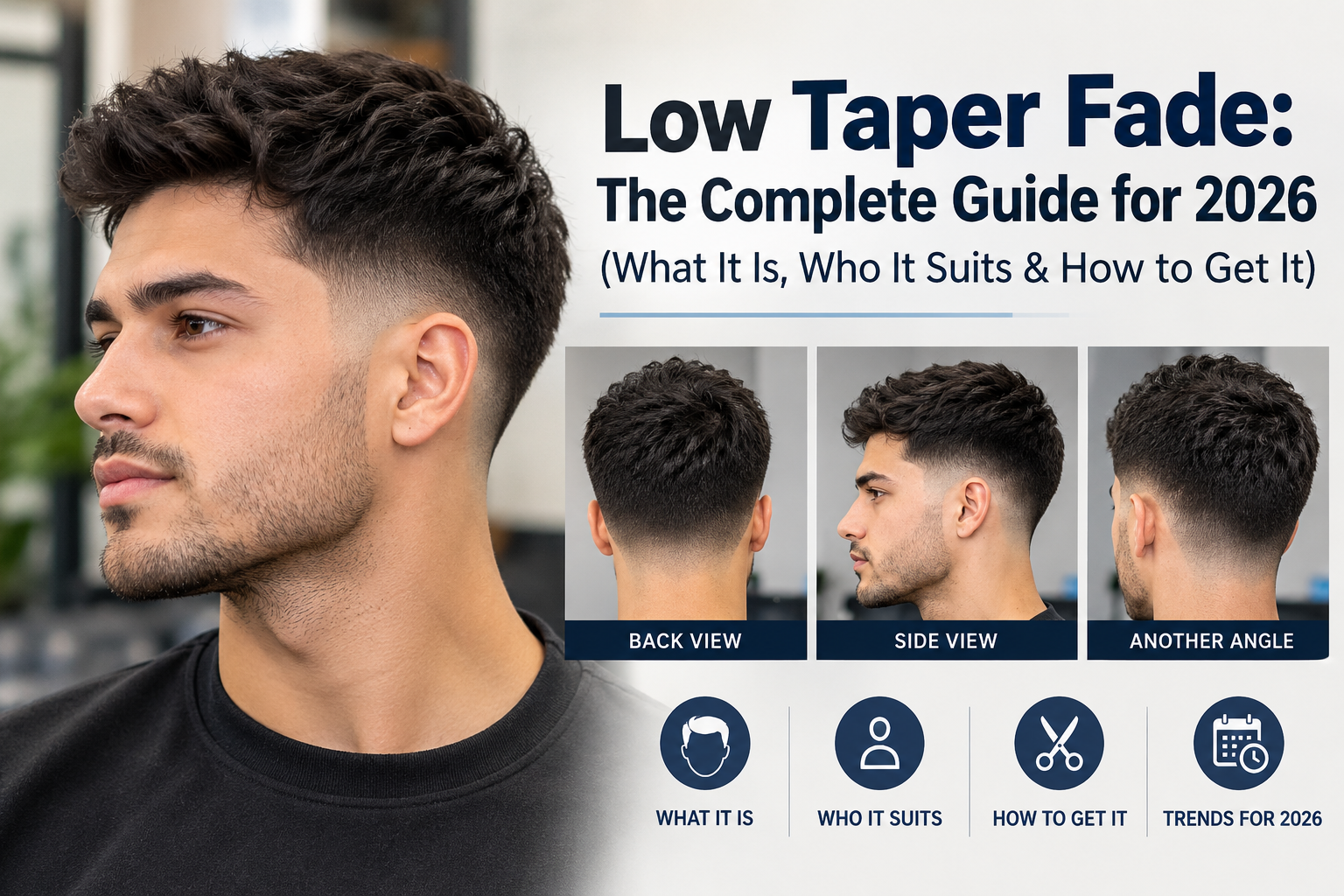
"Taper" and "fade" are probably the two most confused words in men's haircuts. Some barbers use them interchangeably, some treat them as completely different cuts, and the internet mixes them up constantly. The good news is that the difference is simple once you see it, and knowing it will instantly improve the haircuts you get.
The Short Answer
- A taper gradually shortens the hair at the hairline: the sideburns and the back of the neck. Most of the sides keep noticeable length. It is subtle and conservative.
- A fade gradually shortens the hair down to very short or bare skin, usually over a larger area of the sides and back. It is higher contrast and more noticeable.
Think of it like this: every fade is a type of taper, but not every taper is a fade.
Taper vs Fade Comparison Table
| Taper | Fade | |
|---|---|---|
| Area affected | Hairline edges (sideburns, nape) | Sides and back, sometimes up to the temples or higher |
| Shortest length | Usually #1 to #2, occasionally shorter at the very edge | Often #0, bare blade or skin |
| Visible skin | Little or none | Moderate to a lot |
| Look | Classic, natural, polished | Modern, sharp, high contrast |
| Grow-out | Very slow and forgiving | Faster to look grown-out |
| Upkeep | Every 3–5 weeks | Every 1–3 weeks |
| Works best for | Offices, conservative settings, longer styles | Statement looks, sports, short styles |
What Is a Taper Haircut?
A traditional taper is one of the oldest barbering techniques. The barber leaves the sides and back at a normal length, then gradually shortens only the hair right at the edges so the hairline looks clean and natural instead of blunt. When it grows out, there is no obvious line, just slightly longer edges.
Common taper types include:
- Classic taper: gentle shortening at the nape and sideburns, often scissor-over-comb.
- Low taper: the transition stays very close to the hairline.
- Taper with a natural neckline: no hard line at the back; the hair simply thins out.
What Is a Fade Haircut?
A fade takes the same gradual idea but goes further and shorter. The barber blends hair from longer at the top of the fade down to very short or bare skin at the bottom. The fade can sit at different heights: low, mid or high.
Popular fade types include:
- Skin fade (also called bald fade): goes all the way to bare skin.
- Drop fade: curves down behind the ear.
- Burst fade: radiates around the ear in a semicircle.
- Temple fade: focused on the temples and sideburns only.
So What Is a Low Taper Fade?
The low taper fade is the modern hybrid. It takes the placement of a taper (only the lower edges) and the finish of a fade (very short at the bottom, sometimes skin). The result:
- From the front, the sides look fairly full, like a taper.
- At the sideburns and nape, the blend is tight and clean, like a fade.
- Only a small amount of skin shows, if any.
This is why the low taper fade has become the default request in many barbershops. It gives people the sharpness they want from a fade without the commitment.
Which Should You Choose?
Choose a taper if:
- You work in a very conservative environment.
- You want the longest possible time between cuts.
- You wear your hair long or medium and only want neat edges.
- You have fine or thinning hair and want to avoid contrast.
Choose a fade if:
- You want a sharp, modern, high-contrast look.
- You are happy to visit the barber every two weeks.
- You have a short top style like a crew cut or buzz cut.
- You have a good head shape and want to show it.
Choose a low taper fade if:
- You want the best of both and are not sure which you prefer.
- You want a cut that looks fresh on day one and still decent on day 25.
- You want a style that works with curls, waves, straight hair and coils.
How to Ask for Each One
Because people use these words differently, never rely on one word alone. Describe the result:
- Taper: "Keep the sides at a #3 or #4 and just taper the sideburns and neckline so they grow out naturally. No skin."
- Fade: "Mid skin fade, starting at the temple, down to bare skin, blended into a #3."
- Low taper fade: "Low taper fade, starting at the top of the ear, tight at the bottom with a half guard or skin only at the edge, sides at a #3."
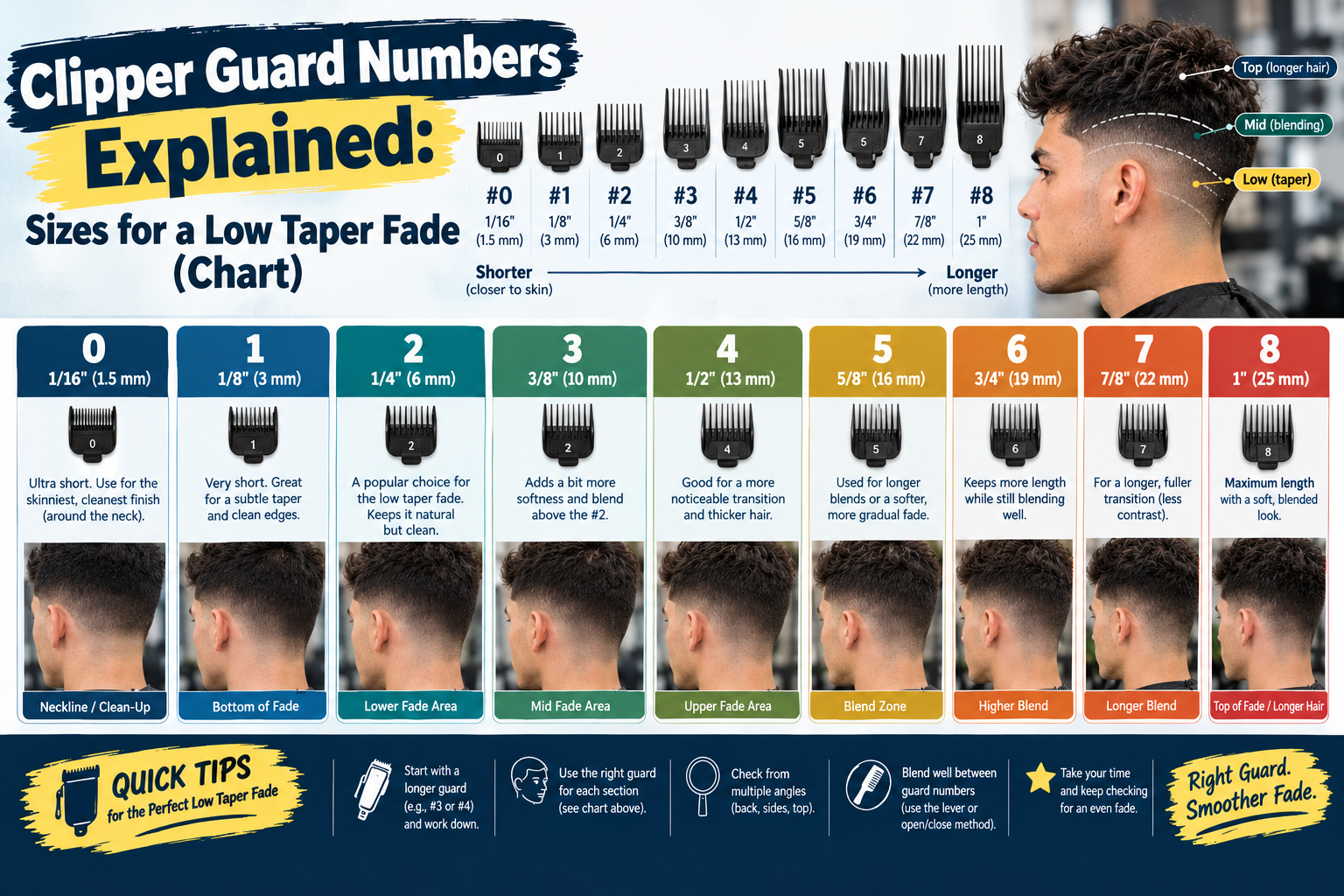
Our step-by-step barber script covers this in more detail, and our guard numbers guide explains what those numbers mean in millimetres and inches.
Common Misunderstandings
"A taper is just a weak fade." Not quite. A taper is its own technique with its own purpose: a natural, long-lasting finish.
"Fades are only for short hair." No. Low fades and tapers work beautifully with long hair, man buns and modern mullets.
"Tapers are old-fashioned." The classic taper is timeless, and the low taper fade is one of the most current cuts of 2026.
Frequently Asked Questions
Is a taper or a fade better for an office job?
A taper, or a low taper fade, is usually the safest. Both look tidy without obvious skin.
Does a taper always go to skin?
No. A traditional taper usually stops at a #1 or #2. Only the very edge might be cleaned with a trimmer.
Which lasts longer, a taper or a fade?
A taper lasts longer because there is no sharp contrast to grow out. A skin fade can look grown-out in under a week.
Can I have a taper with curly hair?
Yes. Curly hair looks fantastic with a taper or a low taper fade because the sides lie flatter while the curls stay full. See our curly hair guide.
What is a "taper fade"?
It is another name for the hybrid: a taper placed at the edges with a fade finish. When people say "taper fade" they usually mean the low taper fade.