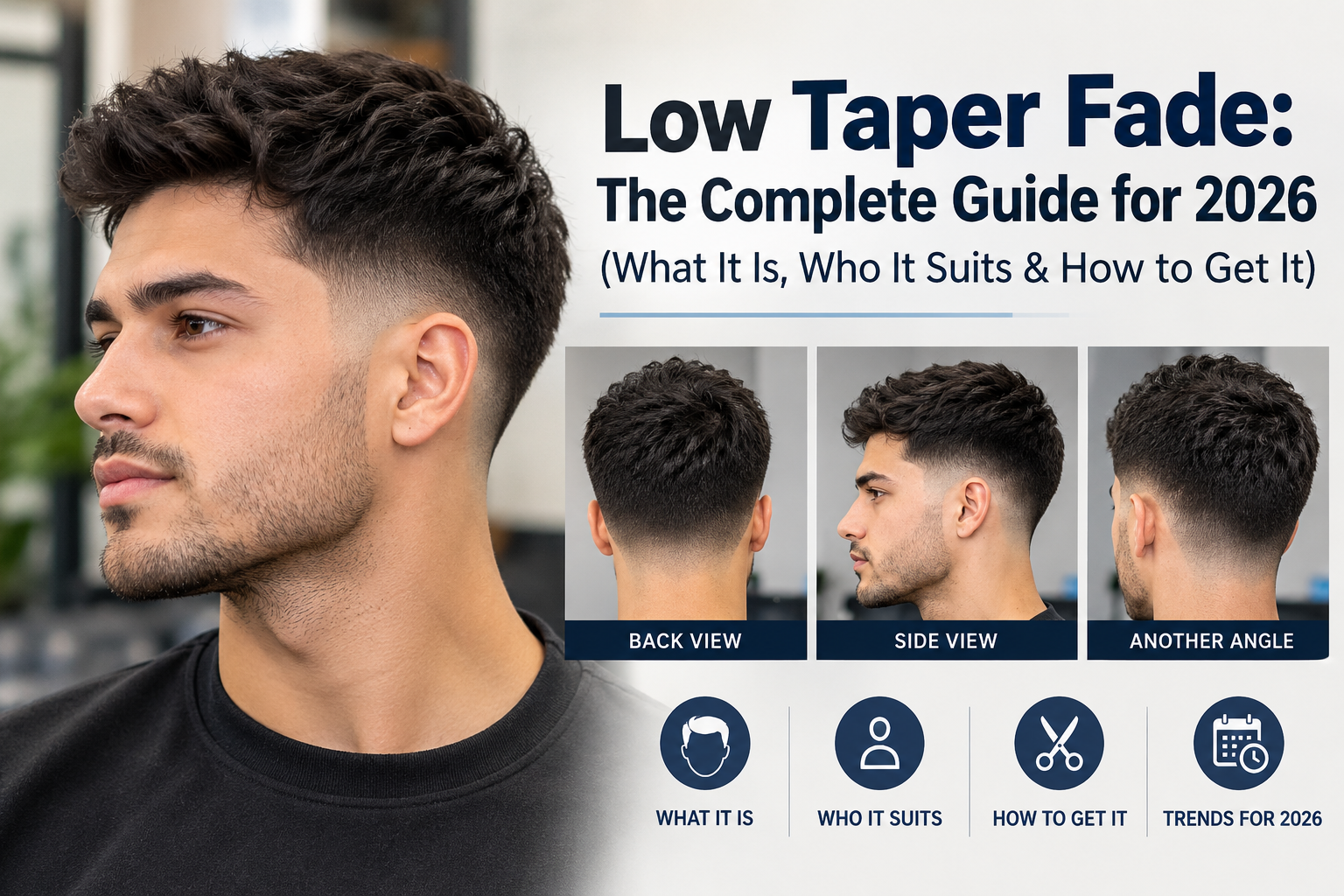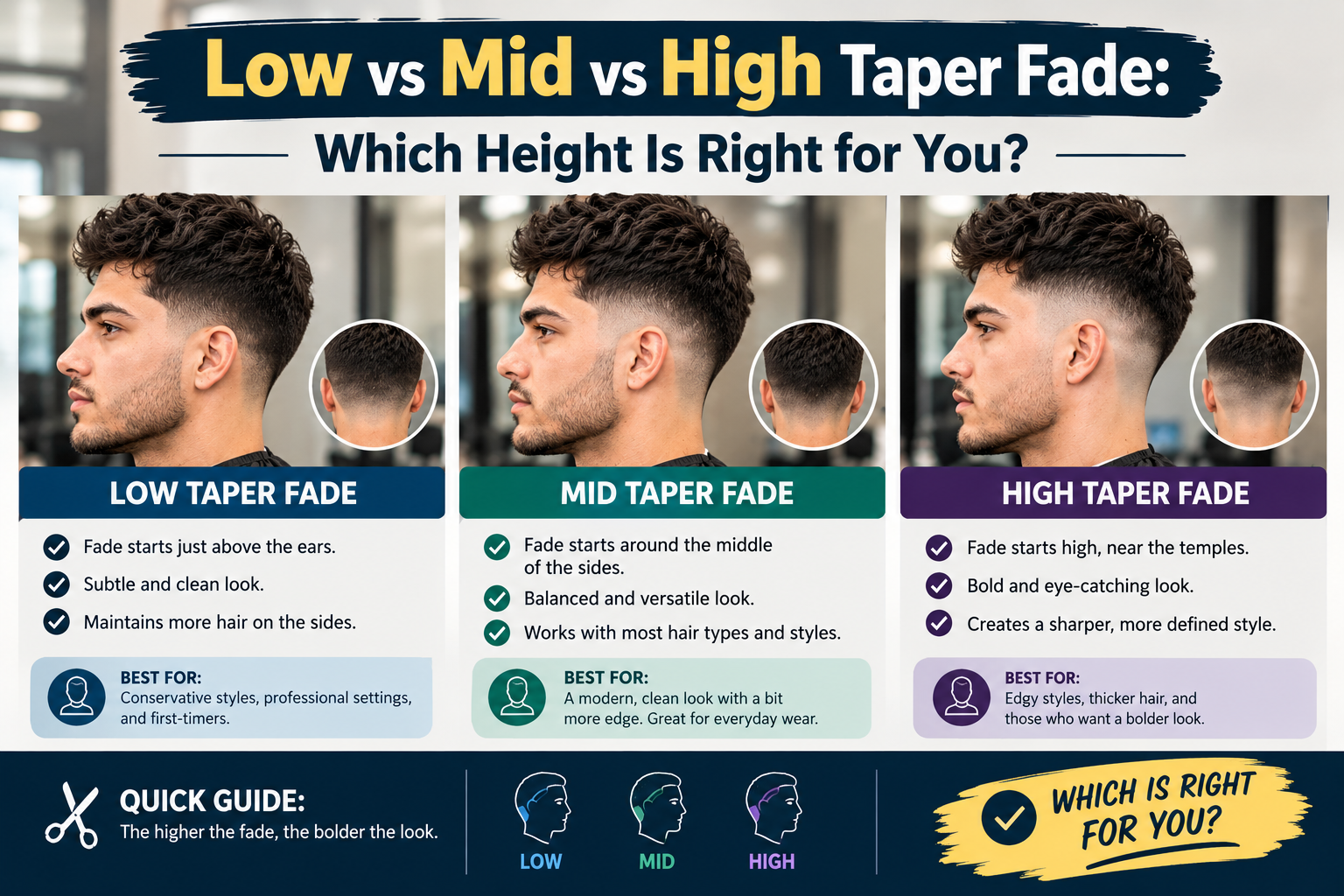
Fade height is the single biggest decision in a fade haircut, and it is the one most people leave to chance. Two cuts can use the same clippers and the same top style and still look completely different because one starts at the ear and the other starts at the temple. This guide compares the low, mid and high taper fade so you can choose with confidence instead of hoping your barber guesses right.
How Fade Height Is Measured
Barbers use landmarks on the head rather than inches, because every head is different. The three you need to know are:
- The top of the ear: the reference point for a low fade.
- The temple: roughly halfway up the side of the head, in line with the outer corner of the eye. The reference for a mid fade.
- The parietal ridge: the widest point of the head, where the side starts curving toward the top. The reference for a high fade.
The "height" of a fade is where the shortest section stops and the blend begins. Everything above that line blends into longer hair.
Side-by-Side Comparison
| Low taper fade | Mid taper fade | High taper fade | |
|---|---|---|---|
| Where it starts | At or just above the top of the ear | Around the temple | Near the parietal ridge |
| Visible skin | Minimal | Moderate | A lot |
| Contrast | Soft | Balanced | Strong |
| Looks | Subtle, classic, professional | Sporty, modern | Bold, edgy |
| Grow-out | Slowest to look untidy | Average | Fastest to look untidy |
| Touch-up | Every 2–3 weeks | Every 2 weeks | Every 1–2 weeks |
| Best for | Most face shapes, offices, first-timers | Defined jawlines, sports | Strong features, statement looks |
The Low Taper Fade
A low taper fade keeps the transition close to the natural hairline. You get a clean sideburn and a tidy neckline, but from the front the sides still look relatively full.
Choose a low taper if: - You want a fade but work in a conservative environment. - Your head has an uneven shape at the back or a flat area at the crown. - You have a long or narrow face and do not want to make it look longer. - You have thin hair and want to avoid strong contrast. - You can only visit the barber every three to four weeks.
Pairs best with: textured crops, curtains, curly tops, long hair, twists and locs.
The Mid Taper Fade
A mid taper raises the transition to the temple area. More skin shows on the sides, and the top looks more separated from the sides, which emphasizes structure.
Choose a mid taper if: - You want more visible contrast but not a dramatic look. - You have an oval or square face that can handle a little more exposure. - You play sports and want the sides cooler and lower maintenance between washes. - Your top style has strong shape, like a quiff or pompadour, and you want to highlight it.
Pairs best with: quiffs, comb overs, crew cuts and short textured fringes.
The High Taper Fade
A high taper starts near the top of the side of the head. Most of the sides are very short or bare, and the top sits on them like a block.
Choose a high taper if: - You want a striking, high-contrast look. - You have a strong jaw and cheekbones and want to emphasize them. - You have a round face and want to create the illusion of more height. - You visit the barber weekly or every ten days.
Think twice if: your head has bumps or flat spots, you have very fine hair on top, or you want a cut that survives a month between visits.
How Fade Height Changes Your Face Shape
The basic rule: the higher the fade, the narrower and longer the head looks.
- Round faces often benefit from a mid or high fade with height on top, because it creates vertical lines.
- Long or oblong faces usually look best with a low taper, which keeps width at the sides.
- Square faces handle any height; a mid fade is a great balance.
- Oval faces suit everything.
- Diamond or heart-shaped faces usually prefer a low or mid fade with some texture on top to balance a narrower chin.
Our face shape guide has visual explanations and style picks for each shape.
What About Drop, Burst and Temple Fades?
Fade height is not always a straight line around the head. Popular variations change the shape:
- Drop fade: the fade line curves down behind the ear toward the nape. Often starts low or mid.
- Burst fade: the fade radiates in a semicircle around the ear, leaving length at the back. Common with mullets and mohawks.
- Skin taper: any height, but the shortest section goes all the way to bare skin.
How to Tell Your Barber the Height You Want
Barbers are visual. Use your finger to show the exact line where you want the shortest part to stop. Then say:
- "Low taper, starting at the top of my ear, lower at the back," or
- "Mid taper, starting at the temple, blended up to a #3," or
- "High taper, up to the parietal ridge, down to skin."
If you are between two heights, ask for the lower one. A barber can always take it higher before you leave the chair. Our barber script guide has more phrases to use.
Which Height Grows Out Best?
Without a doubt, the low taper. Because so little skin is exposed, new growth blends naturally for weeks. A high skin fade can look grown-out in as little as five to seven days on fast-growing hair. If budget or time matters, low is the smart choice. Read how long a low taper fade lasts for a full maintenance schedule.
Our Recommendation
If you have never had a fade, start with a low taper. Live with it for a few weeks. If you want more contrast, move to a mid taper on your next visit. Only jump to a high taper if you love the look and are prepared for frequent touch-ups.
Frequently Asked Questions
Which taper fade looks the most professional?
The low taper fade. It keeps the sides fuller and only cleans up the edges, so it looks neat without drawing attention.
Is a mid taper the same as a mid fade?
They are close, and many barbers use the terms interchangeably. Strictly, a mid taper keeps a little more length and focuses on the hairline, while a mid fade blends to skin over a wider area. Always confirm how short you want the bottom to go.
Does a high taper fade make your face look thinner?
Yes. Removing hair from the sides narrows the overall silhouette, which can slim a round face but may make a long face look longer.
Can I switch from a high fade to a low taper?
Yes, but you need to let the sides grow for three to six weeks, depending on how high and short the old fade was. Your barber will gradually lower the line as the hair grows.
Which fade height is best for thin hair?
Usually a low taper with a #0.5 or #1 at the bottom rather than bare skin. Less contrast keeps attention away from the top.