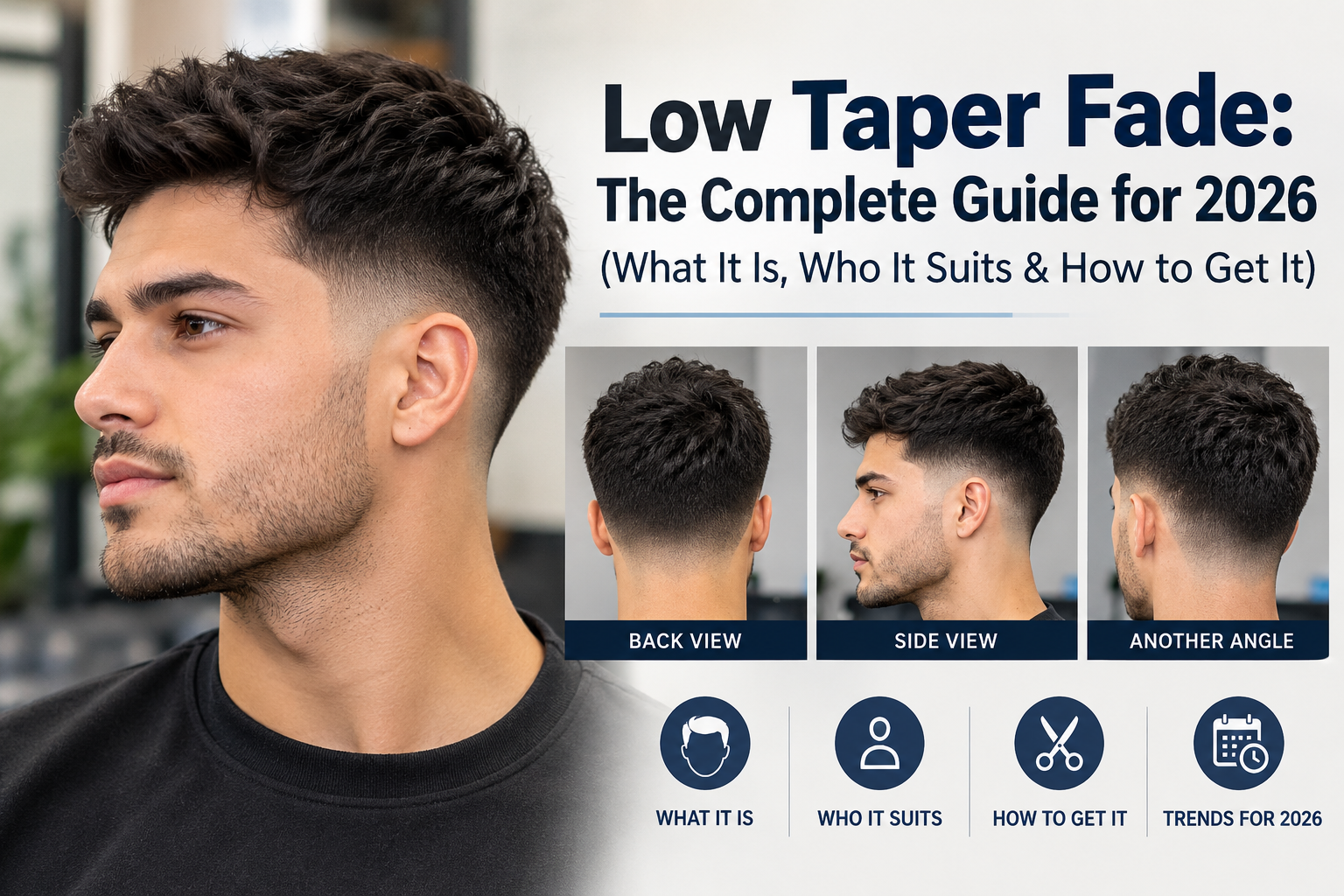
The burst fade gets its name from its shape: instead of running in a straight line around the head, the fade "bursts" outward in a semicircle around the ear. The hair is short around the ear and longer behind it, which leaves length at the back of the head. A low taper burst fade keeps that semicircle compact and low, giving you a sharp but wearable look.
Quick Facts
| Shape | Semicircle around the ear |
| Fade height | Low |
| Bottom length | Skin is common |
| Back of head | Left longer (not faded) |
| Best with | Mullets, mohawks, curly tops, textured crops |
| Touch-up | Every 2 weeks |
Burst Fade vs Regular Low Taper
| Regular low taper | Low taper burst fade | |
|---|---|---|
| Shape | Straight line around the head | Curved arc around the ear |
| Back of head | Tapered at the nape | Left longer |
| Look | Classic, subtle | Edgy, distinctive |
| Best with | Almost anything | Mullets, mohawks, longer backs |
12 Best Low Taper Burst Fade Styles
1. Burst Fade Mullet
The most popular combination: burst fade around the ears, length at the back. See modern mullet.
2. Burst Fade Mohawk
A strip of hair through the center with burst fades on each side.
3. Burst Fade with Curly Top
Curls on top and at the back. See curly hair.
4. Burst Fade Textured Crop
Short choppy top with a curved fade. See textured crop.
5. Burst Fade with Textured Fringe
See textured fringe.
6. Burst Fade Afro
Rounded afro with burst fades around the ears. See afro.
7. Burst Fade with Twists
See twists.
8. Burst Fade with Locs
See dreads.
9. Burst Fade with a Line-Up
Sharp front hairline. See line-up.
10. Burst Fade Blowout
Volume on top with a burst fade. See blowout.
11. Burst Fade with a Design
A line following the curve of the burst. See hair designs.
12. Burst Fade Edgar
Sharp fringe plus curved fade. See Edgar.
How to Ask Your Barber
"Low taper burst fade: a semicircle around each ear, down to skin right around the ear, blending out from there. Keep the length at the back of my head; don't taper the nape."
The last sentence is critical, because many barbers will automatically taper the nape.
Who Should Get a Burst Fade?
- People who want something more distinctive than a classic taper.
- Anyone wearing a mullet, mohawk or longer back.
- Curly and coily hair, which shows the curve of the burst clearly.
Maintenance
The curve loses its shape quickly as hair grows around the ear. Refresh every 2 weeks.
Where the Burst Fade Came From
The burst fade grew in popularity alongside the faux hawk and the modern mullet, because both styles need length at the back of the head that a regular taper would remove. Barbers created the semicircle shape so the sides around the ears could be faded clean while the back stayed long. Today it is common with curly tops, mohawks and mullets, and it has become a recognizable style on its own.
Burst Fade Heights
| Version | Where the burst sits | Effect |
|---|---|---|
| Low burst | Tight around the ear | Subtle, wearable |
| Mid burst | Larger arc reaching the temple | More visible, edgier |
| High burst | Wide arc, often with a mohawk | Bold and dramatic |
Burst Fade Pros and Cons
| Pros | Cons |
|---|---|
| Keeps length at the back for mullets and mohawks | Loses its curved shape quickly |
| Distinctive, modern look | Less conservative than a straight taper |
| Shows off curls and coils well | Harder to maintain at home |
Can You Cut a Burst Fade at Home?
It is much harder than a regular low taper because the curve has to be identical on both sides. If you are cutting at home, practice a straight low taper first. Leave the burst to a barber until you are confident with blending.
Frequently Asked Questions
What is a burst fade?
A fade shaped like a semicircle around the ear, leaving the back of the head longer.
Is a burst fade the same as a mohawk?
No, but the two are often combined. A mohawk is the strip of hair down the middle; a burst fade is the curved fade around the ears.
Does a burst fade work for straight hair?
Yes, especially with mullets or textured crops.
Is a burst fade professional?
It is bolder than a classic taper. In conservative workplaces, a straight low taper is safer.